
Most of the small businesses I know don’t have a front desk. The person who would answer the phone is the same person cutting the hair, doing the treatment, teaching the class or fixing the boiler. Plenty of them are my friends.
They’re good at what they do. What they don’t have is a spare pair of hands. And when I looked at where their customers actually went missing, it was rarely the work. It was the phone that rang halfway through an appointment, the website form that waited until the evening, the message answered the next morning, after the customer had already booked somewhere else.
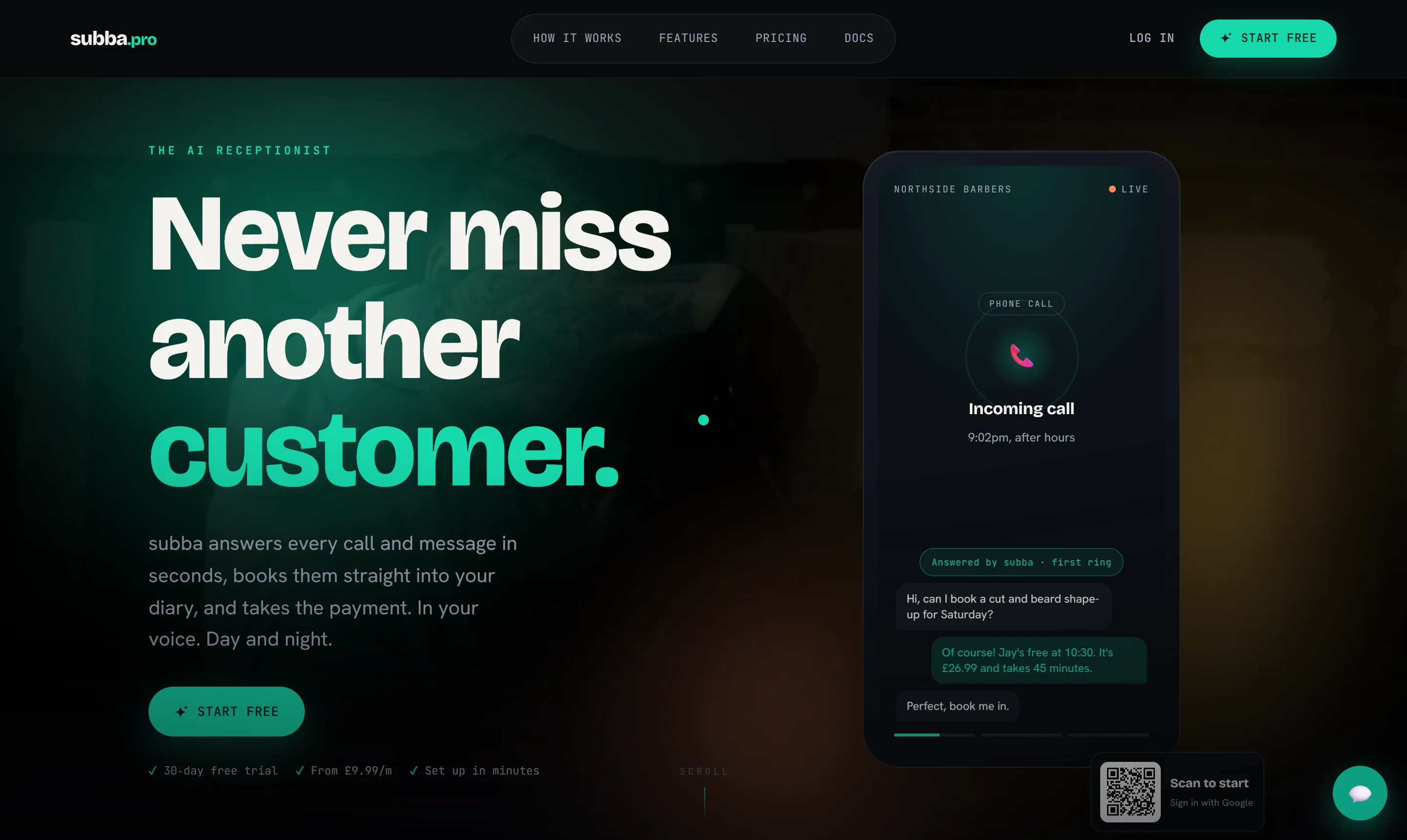
I’ve spent years building websites and software for businesses, so I built them a receptionist. It’s called subba, and this is why it exists, what it does, and what I refused to put in it.
Who did I build subba for?
I built subba for people I know, and that gave me a simple test for every decision: could one of my friends switch it on tomorrow morning, without me sitting next to them?
They don’t want another app to learn, a long setup guide or a sales call. They want enquiries answered, the diary full and fewer people not turning up. So subba had to:
- Work out of the box. Pick your trade, check the services, prices and opening hours it suggests, and it can start answering.
- Fit around what they already have. It adds to an existing website, works from a booking link they can share anywhere, or comes with a website we build for them.
- Be an easy yes on price. Starter is £9.99 a month, and the first 30 days are free.
- Be honest with their customers. The chat is labelled as an AI assistant, and the phone line says so as soon as it picks up.
If you want to see it working, the chat in the corner of this page is subba. Mine is set up for enquiries rather than bookings, because I don’t sell appointments, but it’s the same assistant.
What goes wrong on a fully booked day?
Picture a good day for a one-person business: booked solid from nine to six, back to back, with a short break for lunch. That’s the goal. It’s also exactly when customers start slipping away.

The phone rings at 09:40, mid-appointment. You can’t answer, and not everyone leaves a voicemail. A website form arrives at 11:15 and sits unread until you check your email that evening. Another call comes in at 14:05, and by the time you ring back, they’ve booked with whoever picked up. A message at 16:20 gets a reply the next morning.
None of those people did anything unusual. They wanted to book, and they asked at a time that suited them. The business was simply busy doing the work that pays the bills.
That’s what makes it such a frustrating problem: the busier and better you are, the more enquiries you miss. And the ones you do catch get answered in the evening, after a full day’s work, which is its own kind of cost.
Why does a fast reply matter so much?
When someone wants to book, they usually want to book now. If you don’t answer, the next business on their list might.
Most of the research on this comes from sales rather than salons, but it’s consistent. The Lead Response Management study, run with Professor Oldroyd of MIT on more than 15,000 leads, found that the odds of qualifying a lead fell 21-fold when the first call came after 30 minutes instead of five. Harvard Business Review’s study of online leads found the same shape over hours: the companies that got back to people within an hour did far better than the ones that waited.
A small business isn’t a sales team, and a haircut isn’t a software deal. But the lesson carries over: the first reply wins a lot of bookings, and it’s very hard to be first when you’re busy with a customer.
That’s the job I wanted subba to do. It isn’t smarter than you, and it doesn’t know your customers the way you do. It’s just always there, so the first reply goes out in seconds, whether it’s 09:40 or 21:47, while you carry on with the person in front of you.
What about people who book and don’t turn up?
Missed enquiries are one leak. The other is the booking that never shows. For a one-person business, a no-show isn’t only lost money: it’s an hour of your day you can’t sell again.
The fix is unglamorous, and it works: remind people. A 2016 meta-analysis in BMJ Open pooled studies of appointment reminders in healthcare and found that people who got a reminder were 23% more likely to attend. No-shows fell from 21% to 15%.

Those were clinics, not barbers, but the reason is the same everywhere: people are busy, and they forget. subba sends a confirmation as soon as someone books and a reminder before the appointment, by email on every plan, or by text with the SMS add-on.
It also makes the no-shows that still happen hurt less. You can take a deposit or the full amount when someone books, paid straight into your own Stripe account. Customers can cancel or move their own booking from a link, within your rules, so you hear about it in time. And when a slot frees up, the waitlist offers it to the next person, so the gap can fill itself.
What does subba actually do?
In one sentence: subba answers your enquiries in seconds, books people into your diary, and helps them turn up and come back.

Day to day, that comes down to five jobs:
- It answers. Your website chat and contact form get a reply within seconds, day or night, in your voice. It quotes your real services and prices, because you’ve told it what they are, and it filters out spam and cold sales pitches before they reach you.
- It books. It offers real free times from your diary, respecting each person’s hours, breaks and time off, and the customer confirms before anything is booked. You can take a deposit or full payment at the same time.
- It reminds. Confirmations and reminders go out on their own. After a visit it can ask for a Google review and nudge regulars when it’s time to book again, if they’ve said yes to hearing from you.
- It keeps everything in one place. Every chat, form and call lands in one inbox, and every customer has a single timeline of their bookings, messages and notes.
- It answers the phone, if you want it to. The AI phone receptionist is an add-on. It starts every call by saying the call is recorded and that it’s an AI assistant, then answers questions and books, just like the chat.
Businesses that need more will find it there too: classes, memberships, a loyalty card, quotes for jobs that need a price first, a small online shop and staff holidays. But those five jobs are the heart of it.
It also fits around what you already have. One line of code adds the chat, booking or a contact form to any website, there’s a WordPress plugin, and if you don’t have a website at all, you can share your booking link anywhere, or we can build one for you.
What did I refuse to build?
This is the part I care about most, because it’s where a lot of software for small businesses quietly works against the people paying for it.
- No commission. subba is a flat monthly price. It takes no cut of your bookings and no fee on your payments, which go straight into your own Stripe account. The only fee on a payment is Stripe’s own.
- Your customers stay yours. subba isn’t a marketplace that puts competitors in front of your customers. Offers and updates only go to people who said yes to them, and they come from you.
- Honest AI. The chat is labelled as an AI assistant. The phone receptionist says it’s an AI in its opening line, and if a caller asks whether they’re talking to a person, it tells them the truth.
- Careful with data. Customers’ names, contact details and messages are encrypted when they’re stored. Their data is never sold and isn’t used to train AI models, and you can export or delete a customer’s data from their profile.
- No lock-in. It’s monthly, and you can cancel any time.
What does subba cost?
I wanted the price to be an easy yes, so the plans differ in just one thing: how many AI enquiries are included each month. An AI enquiry is a chat or contact-form conversation the AI answers. Bookings never count, and spam is free. Everything else, from unlimited bookings to team members, services and forms, is on every plan.
- Starter: £9.99 a month for 50 AI enquiries, free for the first 30 days.
- Pro: £49.99 a month for 300 AI enquiries.
- Studio: £99.99 a month for 750 AI enquiries.
The AI phone receptionist is an add-on from £29.99 a month, and text reminders start at £9.99 a month. If you’d like a website as well, we’ll design, build, host and look after it for £200 one-off. On Starter, adding a website moves you to £19.99 a month.
Is subba right for your business?
It’s built for small, appointment-based businesses where the owner or a small team does the work: hair and beauty, barbers, health and wellness, fitness and classes, and trades that quote and book jobs. If customers book time with you, and you can’t always answer the moment they ask, it will help.
It’s probably not the right fit if someone already sits on your front desk all day, if most of your customers walk in without booking, or if you need a full clinical records system.
Where should you start?
The quickest way to find out is to try it on your own business. Sign up at subba.pro, pick your trade and check the services, prices and hours it suggests. Then add the chat to your site or share your booking link, and send it a test enquiry to see how it replies. Starter is free for the first 30 days.
And if you’re one of the friends I built this for: you know where to find me.